
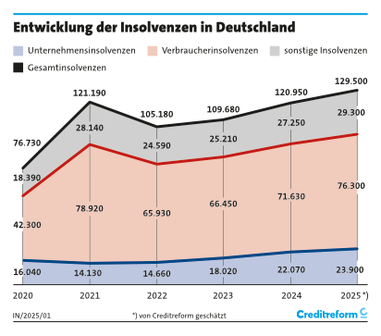
The economic turmoil continues to hit businesses hard. Insolvency activity remains high, with corporate bankruptcies reaching a 10-year high of 23,900 cases. Similar to the increasing consumer debt, the number of personal bankruptcies is also rising significantly.
Company bankruptcies at a 10-year high
The number of insolvent companies in Germany reached its highest level in more than ten years in 2025. During the year, 23,900 companies filed for insolvency – an increase of 8.3 percent compared to the previous year (22,070 cases). However, this increase was significantly lower than in the two preceding years (2023: plus 22.9 percent; 2024: plus 22.5 percent). "Many businesses are heavily indebted, have difficulty obtaining new loans, and are struggling with structural burdens such as energy prices and regulation. This puts massive pressure on small and medium-sized enterprises (SMEs) in particular and is ultimately the death knell for many companies," says Patrik-Ludwig Hantzsch, Head of Economic Research at Creditreform.
Personal bankruptcies are rising significantly
The negative trend continued among consumers as well. The number of personal bankruptcies rose by a further 6.5 percent in 2025 to around 76,300 cases (previous year: 71,630) – the highest level since 2016. "The main reason for this is the increasing over-indebtedness of people," said Hantzsch. Nationwide, 5.67 million citizens are currently considered over-indebted. "High living costs, job cuts, and rising unemployment are pushing many households to their limits," Hantzsch added.
Nearly 20,000 micro-enterprises insolvent
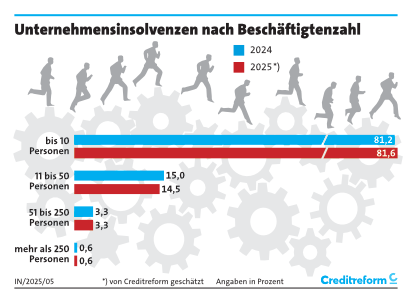
Micro-enterprises with up to ten employees account for the largest share of corporate insolvencies. In this segment, around 19,500 companies filed for insolvency – significantly more than in the previous year (17,900 cases) and representing 81.6 percent of all insolvencies. The increase was moderate for large companies with more than 250 employees: around 140 major insolvencies were recorded in 2025. The healthcare and nursing sectors were particularly hard hit, with several large-scale insolvency cases.
Heavy losses for creditors
According to Creditreform economic research, the financial losses for creditors – including suppliers and banks – remain high. The total losses for 2025 are estimated at around €57 billion – almost on par with the previous year (€59.1 billion). On average, the claims at risk of default amount to more than €2 million per insolvency case. An estimated 285,000 employees were affected by these corporate insolvencies (previous year: 291,000).
Manufacturing sector drives insolvency
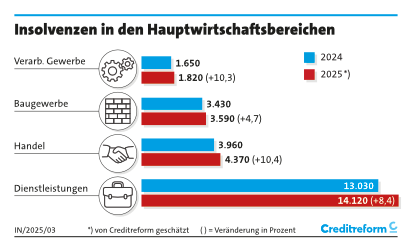
Strong increases were recorded in the manufacturing sector (up 10.3 percent) and in retail trade (up 10.4 percent) over the past twelve months. The rise was less pronounced in the construction sector, where the number of insolvencies increased by only 4.7 percent. Insolvencies in the service sector also rose only moderately this time (up 8.4 percent). In the construction, manufacturing, and service sectors, the number of insolvencies is now around one-third higher than in 2019.
Credit rating deteriorates
Corporate credit ratings – that is, assessments of solvency – show a persistently negative trend in many sectors. The healthcare and social services sector is particularly hard hit. "Rising operating costs, insufficient financing, and complex bureaucratic requirements are placing a massive burden on this sensitive area," explains Bernd Bütow, CEO of Creditreform.
The best credit rating is currently found in the "Mining and Quarrying" sector. At the bottom of the list is the hospitality industry, whose credit rating plummeted during the COVID-19 crisis. While the situation has improved slightly since then, the creditworthiness of restaurateurs remains significantly limited.
Outlook 2026
"The German economy is losing competitiveness. High costs, bureaucracy and the ongoing economic weakness will further drive up the number of insolvencies," warns Bütow.
The German government's planned multi-billion euro investments in infrastructure and defense could boost economic growth and curb the rise in bankruptcies in 2026. Nevertheless, additional structural measures are needed, such as relief from electricity costs, to stabilize the economic base and slow the increase.
Download full analysis here⬇️:

Write a comment